Two agents edited the same config. Both got a 200.

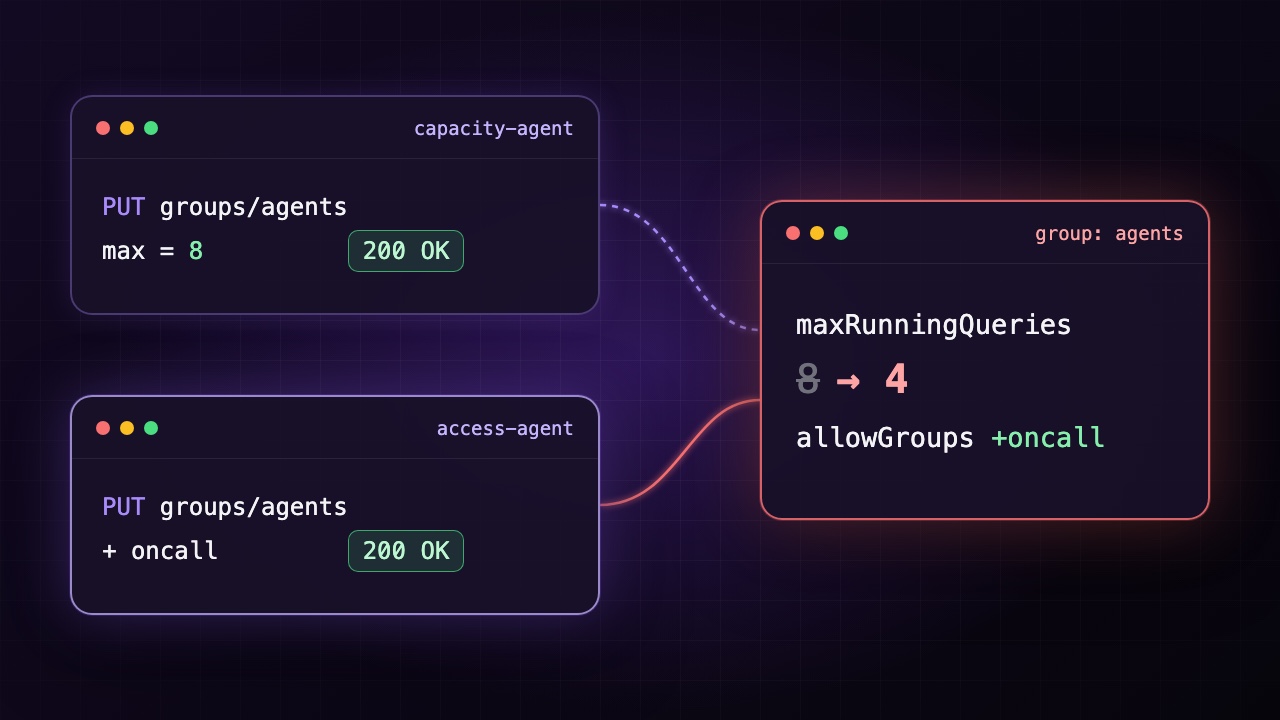
The first agents that touched your data stack only read from it. The next ones change it. One watches the queue and raises a group's concurrency limit when it backs up. Another works through access tickets ("give on-call access to the agents pool") and edits the allow-list. Neither one needs a human to click Save.
That's a reasonable thing to automate. It also brings back a bug most admin UIs have never had to deal with, because people rarely edit the same screen in the same second. Agents on a schedule do it all the time.
A person clicks Save once in a while. Two agents read, change and write the same config every few minutes, and sooner or later one of them writes over the other.
We tried it on QueryFlux's admin API. Both agents' writes returned 200, and one change disappeared. Here's what happened, what stopped it, and what the audit log did and didn't record.
How we ran it
Scoped tokens, If-Match and the audit log are on main and will ship in the next release. They aren't in 0.4.0.
We ran QueryFlux from main with Postgres persistence and a cluster group called agents, with maxRunningQueries: 4. Using the admin user, we created two tokens with the scoped tokens added in #373:
capacity-agent, which raises the group's concurrency when the queue grows;access-agent, which adds IdP groups to the allow-list.
As in an earlier experiment, we scripted the HTTP calls ourselves; no model made them. The tokens, ETags, status codes and audit rows below are real responses from the API. The order of the calls is ours.
1. Give each agent the smallest key
A token is created once and shown once. QueryFlux stores only its SHA-256:
curl -s -u admin:$ADMIN_PASSWORD -X POST localhost:9000/admin/tokens \
  -H 'Content-Type: application/json' \
  -d '{"name": "capacity-agent", "scopes": ["read", "config:write"]}'
There are four scopes. read covers every GET. operate covers actions such as cancelling queries or disabling a cluster. config:write covers every other config change. credentials covers tokens and the admin password. We then had the capacity agent try three things it shouldn't do:
| The agent tries to | Response |
|---|---|
create itself a token with credentials | 403 this needs the 'credentials' scope |
| cancel someone's query | 403 this needs the 'operate' scope |
| list the other tokens | 403 this needs the 'credentials' scope |
A token can't grant scopes it doesn't hold, and config:write doesn't include credentials, so an agent can't promote itself. The error messages also say exactly what's missing. That matters, because an agent acts on whatever the error tells it.
Know how wide config:write is. Scopes cover kinds of action, not individual resources. A token that can change maxRunningQueries can also change routing, guardrails and access control. If an agent should only ever touch one field, give it a narrow tool that makes that one call, and keep the token behind the tool.
2. The update that disappeared
Both agents read the group at the same time, and both saw maxRunningQueries: 4 with ETag: "r1". The capacity agent then raised the limit to 8. The access agent added oncall to the copy it had read earlier and sent that copy back:
capacity-agent  GET  /admin/config/groups/agents   200  r1  max 4, allowGroups []
access-agent    GET  /admin/config/groups/agents   200  r1  max 4, allowGroups []
capacity-agent  PUT  maxRunningQueries = 8         200  r2  max 8
access-agent    PUT  allowGroups += oncall         200  r3  max 4, allowGroups [agents, oncall]
Both agents got a 200 and both reported success. But the group ended up back at 4, because a group update is a PUT of the whole object. The access agent sent back the 4 it had read, along with its own change.
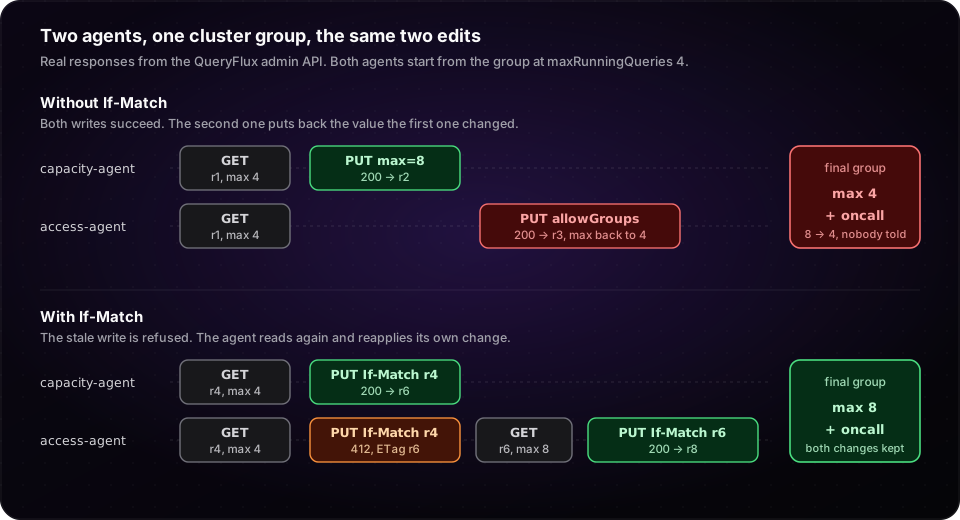
If-Match. Revisions are the real ETags the API returned.Nothing failed, so nothing alerted. The queue the capacity agent was trying to drain keeps growing. Its next run sees 4 again, raises it to 8 again, and the access agent may well undo it again. To anyone reading the logs, it looks like an agent that keeps forgetting what it did.
3. If-Match: refuse the stale write
Every config read returns the config revision as an ETag. Send it back as If-Match, and the write only goes through if nothing has changed since you read:
capacity-agent  GET  groups/agents                     200  r4  max 4
access-agent    GET  groups/agents                     200  r4  max 4
capacity-agent  PUT  If-Match: "r4"   max = 8          200  r6
access-agent    PUT  If-Match: "r4"   += oncall        412  ETag: r6
                     config changed since it was read; read it again
access-agent    GET  groups/agents                     200  r6  max 8
access-agent    PUT  If-Match: "r6"   += oncall        200  r8  max 8, allowGroups [agents, oncall]
Both changes were kept. The 412 also carries the current ETag, and the message tells the agent what to do next in words a model will follow. On the agent's side, the loop is short:
def update_group(name, change, attempts=5):
    for _ in range(attempts):
        r = admin.get(f"/admin/config/groups/{name}")
        body = change(r.json())  # apply the edit to what's there now
        w = admin.put(f"/admin/config/groups/{name}", json=body,
                      headers={"If-Match": r.headers["ETag"]})
        if w.status_code != 412:
            w.raise_for_status()
            return w.json()
    raise RuntimeError(f"{name} kept changing; giving up without writing")
The important part is that change runs on the fresh copy each time. Retrying with the body from before the 412 just produces the lost update again, with more steps.
Two things about the ETag that surprised us:
- It's one revision for all of config. We had the access agent read the routing config at
r8, then let the capacity agent edit the group. The access agent'sPUTof the routing config it had read, completely unchanged, got a412atr10, even though it touched something different. You'll see more retries than real conflicts, but you won't get a merge. - It can go up by more than one per write. A conditional write claims the revision and then writes, so we saw
r4jump tor6. Never work out the next ETag yourself. Use the one the response gives you.
If-Match narrows the race, but it doesn't close it yet. From reading the code: QueryFlux claims the new revision before it writes the group, so a read that lands between the two gets the new ETag with the old config. A write based on that read passes If-Match, and the lost update comes back. The window is short, and our run didn't hit it, but until the check and the write happen together, an agent that must never lose a change should also serialize its writes, for example by running one config agent at a time.
If-Match is optional. A write without it behaves as before, unconditionally. The server can't make your agents use it, so build it into whatever tool or client library they write through.
4. What the audit log saw
Every successful write was there, attributed to the token that made it:
basic:admin             POST  /admin/tokens                 201
basic:admin             POST  /admin/tokens                 201
basic:admin             PUT   /admin/config/groups/agents   200
token:025a7004-1a06-4d  PUT   /admin/config/groups/agents   200
token:06d20609-742c-4c  PUT   /admin/config/groups/agents   200
...
That's enough to answer who wrote to this group, and when. It isn't enough to answer what changed. The row for the access agent's write in step 2, the one that put 4 back, looks the same as any other successful PUT. The log records method, path and status, not the body or a diff.
The log was also missing some requests: the three 403s from step 1 and both 412s. Our docs say every request needing a scope other than read is recorded along with its status, but refused requests return before the audit write. An agent repeatedly trying to create itself a credentials token is exactly what you'd want an audit log to show.
What the run caught in our own stack
| What we found | Evidence | What to do for now |
|---|---|---|
Refused admin requests aren't audited. 403 and 412 responses return before the audit write. | 3 denials and 2 conflicts, none in GET /admin/audit. | Log refused requests in the agent's own tooling, or at a gateway in front of the admin port. |
| The audit log has no diff. | The write that reverted maxRunningQueries looks like any other 200. | Have the agent tooling record a redacted diff and the response status, not full bodies: cluster configs can carry passwords and tokens. |
| Rows name the token by id. | token:025a7004-…. Turning an id into a name needs GET /admin/tokens, which needs credentials. | Keep a list of token ids and agent names when you create tokens. |
If-Match is opt-in. | Writes without it are unconditional. | Send it from every agent tool, and treat a write without it as a bug. |
If-Match has a gap. The revision is claimed before the group is written. | From the code, not our run: a read in between gets the new ETag with the old config. | Serialize writes from agents that must not lose a change. |
Before an agent gets an admin token
- Give each agent its own token, and only the scopes it needs. Separate tokens are the only way to tell agents apart in the audit log, and to revoke one without the others.
- Wrap broad scopes in narrow tools.
config:writecovers all config, so if the agent's job is one field, expose one field. - Always send
If-Match, and reapply the change after a412. Read again and redo the change. Never resend the old body. - Keep your own record of changes. Until the audit log stores diffs and refusals, the agent's tooling is the only place with the full story.
- Revoke quickly.
DELETE /admin/tokens/{id}takes effect on the next request. Make sure the person on call knows that.
Agents that change config aren't more dangerous than people who change config. They're faster, they run at the same time, and they don't notice when something looks off. The proxy has to catch the conflict, because the agents won't.
Read admin API access for scopes, tokens, ETags and the audit log, and give agents SQL, not the keys for the query side of the same problem.