Your LLM speaks Postgres. Your engines don't.

Ask a model for SQL and you'll usually get Postgres. Sometimes Snowflake. It writes created_at::date, ILIKE, DISTINCT ON, IFF, QUALIFY, because that's what most of the SQL on the internet looks like.
Your agent's queries, though, run on whatever is behind the endpoint: Trino over the lake, DuckDB on a laptop, ClickHouse for events, StarRocks for dashboards. A proxy that translates between dialects sounds like the fix, and QueryFlux has one. So we measured what it fixes, and what it doesn't.
An error costs the agent a retry. A wrong answer costs someone a decision, and nothing tells them it's wrong.
Translation got rid of most of the errors. It also produced more wrong answers than sending the SQL unchanged did, and none of them raised an error.
How we ran it
We wrote 20 queries in the style models tend to use: 13 in Postgres and 7 in Snowflake. Each one is a common idiom, such as a cast, a date bucket, a median, a top row per group or a ratio. We ran them against a 24-row orders table loaded into four engines:
- Trino 484
- DuckDB 2.0.0
- ClickHouse 26.8
- StarRocks 4.1.6
Each query ran four ways:
- As written. This is what the MCP frontend does when the agent doesn't pass
dialect: QueryFlux sends the SQL as it is. - Translated. The agent passes
dialect, and no catalog is configured, so sqlglot translates on syntax alone. - Translated with schema. A catalog is configured, so sqlglot also knows the column types.
- Strict. The same as 3, with
translation.mode: strict.
We made the same sqlglot calls QueryFlux makes, with the version we pin (30.24.0). We also ran a sample through a real QueryFlux MCP endpoint with embedded DuckDB, and it matched.
We checked every result against the answer the source dialect gives. For Postgres queries, that's the same SQL run on Postgres 16. We had no Snowflake account, so for Snowflake queries we wrote the equivalent query in Postgres from Snowflake's documented behaviour. Numbers are compared to four decimal places.
We chose the idioms, so this doesn't measure how often models write them. It shows what happens when they do.
As written: lots of errors, and that's the good case
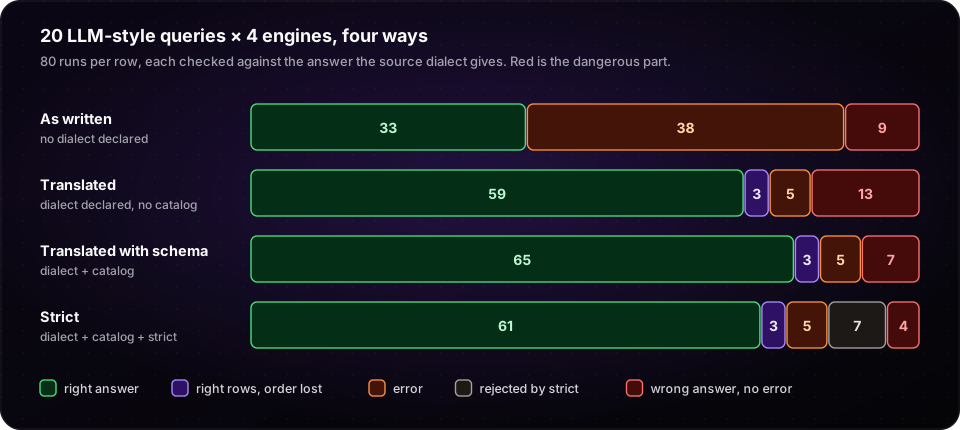
Sending model-written SQL unchanged failed 38 times out of 80. Trino doesn't know ::. StarRocks doesn't know ILIKE. Nobody but Snowflake knows IFF. That looks bad, but an error is something an agent can recover from. It reads the message, rewrites and tries again.
The 9 that ran and returned the wrong answer are the problem. The clearest one was on StarRocks:
SELECT customer || ' (' || region || ')' AS label FROM orders
In Postgres that builds globex (EU). In StarRocks, as in MySQL, || is logical OR by default, so every row came back NULL. There was no error, just a column of nulls for the agent to explain.
Translation fixes the loud failures and creates quiet ones
Declaring the dialect turned 24 errors into right answers, and 3 more into the right rows in the wrong order. sqlglot handles the common cases well: ::date becomes CAST(... AS DATE), ILIKE becomes LOWER(...) LIKE LOWER(...) on Trino and StarRocks, || becomes CONCAT, and QUALIFY becomes a subquery.
But wrong answers went up, from 9 to 13. Six queries that used to fail now returned wrong results, and only two wrong answers were fixed. Fewer errors meant fewer chances for anyone to notice. Here are the ones that surprised us.
A date format that isn't one. The model wrote Snowflake:
SELECT TO_VARCHAR(created_at, 'YYYY-MM') AS ym, COUNT(*) AS n FROM orders GROUP BY 1
For Trino, the translation was DATE_FORMAT(created_at, 'YYYY-MM'). Trino's DATE_FORMAT expects %Y-%m, and a pattern with no % is printed as it is. The monthly breakdown came back as one row:
YYYY-MM 24
On DuckDB, ClickHouse and StarRocks the format was dropped and the call became a plain CAST, so "per month" turned into one group per timestamp. The same idea written in Postgres (to_char(created_at, 'YYYY-MM')) translated correctly to '%Y-%m' on all four engines. The intent was the same, but the source dialect decided the outcome.
45 days became 10,971. The Postgres idiom for the span between two timestamps is:
SELECT round(extract(epoch FROM max(created_at) - min(created_at)) / 86400) FROM orders
The StarRocks translation is UNIX_TIMESTAMP(MAX(created_at) - MIN(created_at)). StarRocks subtracts two DATETIMEs as if they were numbers, so the result was 20261021155600 − 20260906132200 = 115023400. That number then went through UNIX_TIMESTAMP and came out as 10,971 days. On Trino the same translation failed with a cast error. That's the better failure.
A median that's an estimate. percentile_cont(0.5) WITHIN GROUP (ORDER BY amount) became APPROX_PERCENTILE(amount, 0.5) on Trino, which has no exact equivalent. The true median is 107.015, and Trino returned 109.19. The result is close, plausible and wrong, and nothing in it says "approximately". Even DuckDB, which runs the original as written, returned 107.01, because its median of a DECIMAL(10,2) column keeps the column's two decimal places.
Same SQL, two meanings
This query is valid, unchanged, in Postgres, Snowflake, Trino, DuckDB, ClickHouse and StarRocks:
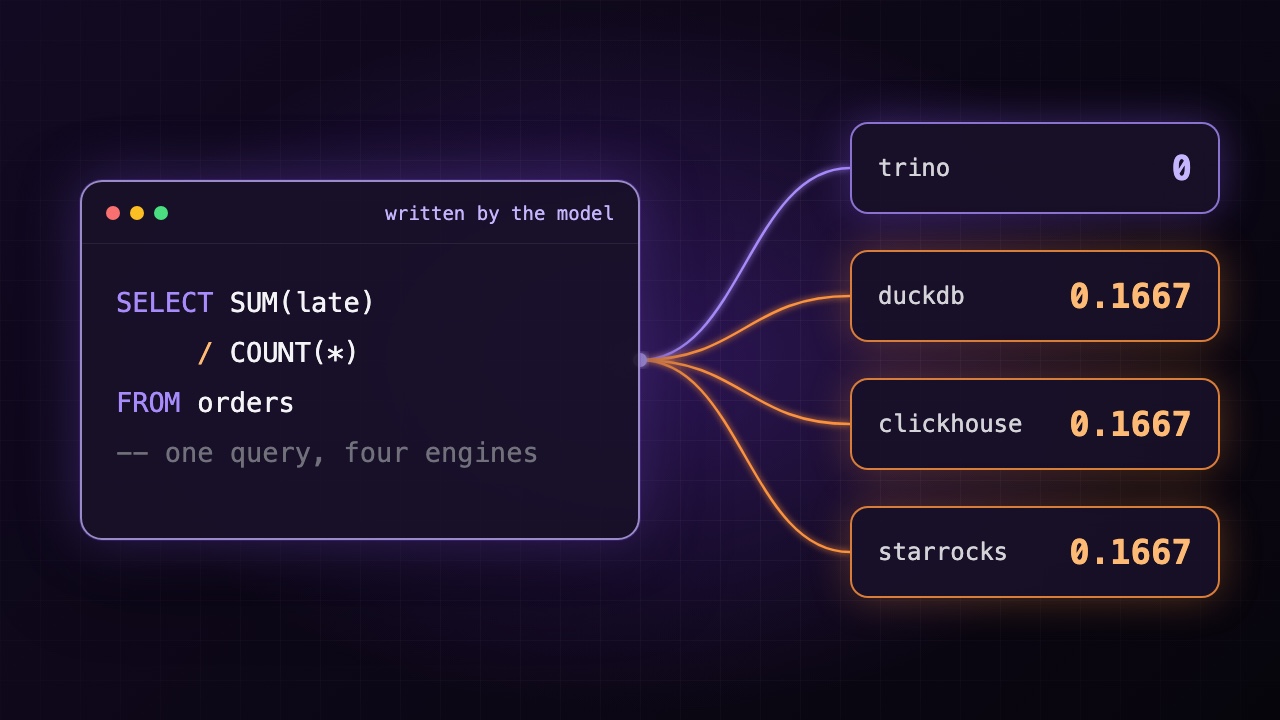
SELECT SUM(CASE WHEN status = 'Delayed' THEN 1 ELSE 0 END) / COUNT(*) AS late_rate FROM orders
It doesn't mean the same thing in all of them. Postgres and Trino divide integers as integers and return 0. Snowflake, DuckDB, ClickHouse and StarRocks return 0.1667. No parser can spot the difference, because the text is identical.
So dialect isn't really about syntax. It tells QueryFlux what the query means:
| Model wrote | dialect passed | Engine | Catalog | Result | Source dialect says |
|---|---|---|---|---|---|
| Postgres | postgres | DuckDB, ClickHouse, StarRocks | no | 0.1667 | 0 ✗ |
| Postgres | postgres | DuckDB, ClickHouse, StarRocks | yes | 0, via CAST(TRUNC(...) AS BIGINT) and similar | 0 ✓ |
| Snowflake | none | Trino | n/a | 0 | 0.1667 ✗ |
| Snowflake | snowflake | Trino | either | 0.1667, via CAST(... AS DOUBLE) | 0.1667 ✓ |
Without column types, sqlglot can't tell that SUM(...) is an integer, so the Postgres-to-DuckDB translation left / alone. With a catalog, it knew the types and kept Postgres's integer division. This is the main reason the schema-aware row in the chart has 7 wrong answers and not 13.
Look at what "correct" means here, though. With a catalog, QueryFlux faithfully reproduced the Postgres answer of 0, but the model almost certainly wanted a late rate of 16.7%. Translation is faithful to the dialect, not to what the model meant. If a model writes Postgres out of habit while thinking in Snowflake, a correct translator carries that mistake into every engine.
Strict mode filters; it doesn't verify
Strict mode tells sqlglot to raise an error instead of skipping a construct it can't translate. It brought silent wrong answers down to 4, and it refused 7 queries before they reached an engine. Here's what the refusals were:
- 3 real catches.
TO_VARCHARwith a format, aimed at DuckDB, ClickHouse and StarRocks:Argument 'format' is not supported for expression 'ToChar' when targeting DuckDB. - 4 false alarms. These were ordinary queries like
GROUP BY 1 ORDER BY 1aimed at StarRocks. Postgres sortsNULLlast by default, and sqlglot can't express that next to a positionalORDER BY, so it refused queries that worked perfectly well in best-effort mode.
The 4 wrong answers that got through were the Trino DATE_FORMAT, the Trino approximate median, the StarRocks epoch and DuckDB's rounded median. Strict mode catches what sqlglot knows it can't translate. It can't catch what sqlglot gets wrong without realising it.
What the run caught in our own stack
As in our last post, following the queries turned up places where the behaviour doesn't match what we'd assumed:
| What we found | Evidence | What to do for now |
|---|---|---|
| Snowflake-dialect SQL didn't get schema-aware translation. sqlglot's optimizer upper-cases unquoted Snowflake identifiers, and our schema used lowercase names, as Trino and Iceberg catalogs report them. | All 7 Snowflake queries failed the optimizer with errors like Column 'AMOUNT' could not be resolved, and fell back to translation without types. | Look for translation.reason = optimize_error in query history, and queryflux_translation_fallback_dialect_only_total in metrics. |
DISTINCT ON and QUALIFY lose their final ordering on Trino. The rewrite into a ROW_NUMBER() subquery puts the ORDER BY inside the window and not on the outer query. | The right 6 rows, in no particular order. | If order matters, ask agents for ROW_NUMBER() in a subquery with an explicit outer ORDER BY. |
| Strict mode refuses fine queries headed for StarRocks. | 4 of 7 strict refusals were queries that returned correct results in best-effort mode. | Use strict mode per environment, and check what it refuses before turning it on everywhere. |
These are sqlglot behaviours, not QueryFlux bugs, but QueryFlux is the one sending the result to your engine, so we treat them as ours.
Make the dialect a contract
None of this is a reason to stop translating. Going from 33 right answers to 65 is a big improvement. It's a reason to treat the dialect as part of the contract between the model and the proxy:
-
Choose one dialect for your agents, and say it twice. Name it in the system prompt ("write PostgreSQL") and pass the same value as
dialecton everyexecute_query. A declaration the model doesn't actually follow is worse than none. -
Configure a catalog. Types are what turn
/into the right kind of division. Without them, translation only works on syntax. -
Watch for fallbacks. Query history records
translation.statusandreasonon every query that reaches translation. Cache hits, and queries stopped before translation, have no translation outcome, so a missing value isn't a failure. A sudden increase infallbackmeans the agents are writing something your setup can't fully translate. -
Turn known silent failures into loud ones. A fixup script that raises an exception sends the original SQL through in best-effort mode, where Trino rejects
TO_VARCHAR, and rejects the query outright in strict mode. Both outcomes beatYYYY-MM | 24:import sqlglotimport sqlglot.expressions as expdef transform(sql: str, src: str, dst: str) -> str:# In Trino, a DATE_FORMAT pattern with no % comes back as a literal.if dst != "trino":return sqlfor fn in sqlglot.parse_one(sql, dialect=dst).find_all(exp.TimeToStr):fmt = fn.args.get("format")if isinstance(fmt, exp.Literal) and "%" not in fmt.this:raise ValueError(f"date format {fmt.this!r} has no % directives")return sql -
Keep a set of golden questions. Choose ten questions whose answers you already know, ask them through the proxy on every engine an agent can reach, and run them again whenever you upgrade an engine, sqlglot or QueryFlux. That's all this post did.
Models will keep writing the SQL they've seen most often. The proxy is the one place that knows both what the model wrote and where it's going to run, so that's where to check that the answer still means the same thing.
Read about query translation and the MCP dialect parameter, then try it with the MCP quickstart.